Immunology has a way of feeling fine in lecture and then falling apart in a question bank. You knew what IL-4 does. You knew what CD40 ligand is. But when a vignette describes a toddler with recurrent infections and asks for the defective protein, everything blurs together.
That's not a you problem. Immunology is a dense web of cells, receptors, and cytokines, and most preclinical courses teach it as a list. Step 1 tests it as a story: a patient, a pattern of infections, and one broken piece of the immune system.
This guide gives you the high-yield topics, a way to organize them, and two practice questions so you can see how the exam actually asks about them.
How Much Immunology Is on USMLE Step 1?
Most immunology USMLE Step 1 questions are clinical vignettes built on six themes: innate vs adaptive immunity, MHC I and II, T-cell subsets and cytokines, hypersensitivity types I to IV, immunodeficiencies, and transplant rejection with the immunosuppressants used to prevent it. Vaccines show up too, usually as a question about live vs inactivated types. The USMLE content outline lists immune system topics as their own category and folds them into other systems as well, so check usmle.org for the current breakdown.
The good news is that the core list is finite. You don't need a graduate-level immunology textbook. You need to recognize patterns quickly and connect each one to a mechanism, a lab finding, or a drug.
The Building Blocks: Innate, Adaptive, and MHC
Innate vs Adaptive Immunity
Innate immunity is fast, nonspecific, and has no memory: neutrophils, macrophages, dendritic cells, NK cells, complement, and physical barriers. It recognizes broad patterns on microbes through receptors like Toll-like receptors. Adaptive immunity is slower on first exposure, highly specific, and builds memory: T cells and B cells, with antibodies doing much of the B-cell work.
MHC I vs MHC II
| MHC I | MHC II | |
|---|---|---|
| HLA genes | HLA-A, -B, -C | HLA-DP, -DQ, -DR |
| Found on | All nucleated cells (not RBCs) | Antigen-presenting cells |
| Presents | Endogenous antigens, like viral proteins | Exogenous antigens, taken up from outside |
| Binds | CD8+ T cells | CD4+ T cells |
| Classic detail | Paired with beta-2 microglobulin | Invariant chain blocks the groove until loading |
A quick memory aid: multiply the MHC number by the CD number and you get 8 (MHC I with CD8, MHC II with CD4).
T-Cell Subsets, Cytokines, and Hypersensitivity
Helper T-Cell Subsets
- Th1: driven by IL-12, secretes IFN-gamma, activates macrophages. Think intracellular infections and granulomas.
- Th2: secretes IL-4, IL-5, IL-10, and IL-13. Drives IgE class switching and eosinophils. Think allergy and helminths.
- Th17: induced by TGF-beta and IL-6, secretes IL-17 and recruits neutrophils. Think mucosal defense against extracellular bacteria and fungi.
- Treg: CD4+ CD25+ cells that express FOXP3 and secrete IL-10 and TGF-beta to dampen responses. FOXP3 problems lead to IPEX syndrome.
Cytokines Worth Memorizing
IL-1 and IL-6 cause fever (IL-6 also drives acute-phase proteins). IL-8 is a major neutrophil chemotactic factor. IL-2 stimulates T-cell growth, which is why so many immunosuppressants target it. TNF-alpha mediates septic shock and granuloma maintenance, which explains why patients starting TNF inhibitors get screened for latent TB.
Hypersensitivity Types I to IV
| Type | Mechanism | Classic examples |
|---|---|---|
| I | IgE on mast cells cross-linked by antigen, immediate release of histamine and other mediators | Anaphylaxis, allergic asthma, hives |
| II | Antibodies against antigens fixed on cells or tissue | Autoimmune hemolytic anemia, Goodpasture syndrome, Graves disease, myasthenia gravis, acute rheumatic fever |
| III | Antigen-antibody complexes deposit in tissue and activate complement | SLE, post-streptococcal glomerulonephritis, serum sickness, Arthus reaction |
| IV | T-cell mediated, delayed, no antibodies involved | Contact dermatitis, PPD skin test, type 1 diabetes, multiple sclerosis |
Types I to III are antibody-mediated. Type IV is the only one driven by T cells, and it's the one that takes days to appear.
Immunodeficiencies, Transplant Rejection, and Vaccines
Immunodeficiencies
Learn each one as a triad: what's broken, what infections it causes, and the clue that gives it away.
- Bruton agammaglobulinemia: BTK defect, X-linked recessive. B cells fail to mature, so all immunoglobulins are low. Recurrent bacterial infections start after about 6 months, once maternal IgG fades. Scant lymph nodes and tonsils.
- DiGeorge syndrome: 22q11.2 deletion, 3rd and 4th pharyngeal pouches fail to develop. Thymic aplasia with T-cell deficiency, hypocalcemia from absent parathyroids, and conotruncal heart defects.
- SCID: most often an IL-2 receptor gamma chain defect (X-linked) or adenosine deaminase deficiency (autosomal recessive). Severe infections of every kind and an absent thymic shadow. Treated with stem cell transplant.
- Chronic granulomatous disease: NADPH oxidase defect, so phagocytes can't make a respiratory burst. Infections with catalase-positive organisms like S. aureus, Aspergillus, Burkholderia cepacia, Serratia, and Nocardia. Abnormal dihydrorhodamine flow cytometry.
- Leukocyte adhesion deficiency type 1: CD18 integrin defect. Delayed umbilical cord separation, high neutrophil counts in the blood, and infections without pus.
- Hyper-IgM syndrome: most often a CD40 ligand defect, so B cells can't class switch. High IgM, low IgG, IgA, and IgE. Pneumocystis and Cryptosporidium infections.
- Wiskott-Aldrich syndrome: X-linked WAS gene defect. Thrombocytopenia with small platelets, eczema, and recurrent infections.
- Selective IgA deficiency: the most common primary immunodeficiency. Often silent, but can cause sinopulmonary and GI infections and anaphylaxis to IgA-containing blood products.
- Terminal complement (C5 to C9) deficiency: recurrent Neisseria infections. C1 esterase inhibitor deficiency causes hereditary angioedema, and ACE inhibitors are contraindicated.
Transplant Rejection
- Hyperacute: within minutes, from preformed recipient antibodies against donor antigens. The graft turns mottled and cyanotic.
- Acute: weeks to months, mainly recipient T cells reacting to donor MHC, sometimes with antibody involvement.
- Chronic: months to years, with gradual fibrosis and vascular damage. In lung transplants it shows up as bronchiolitis obliterans.
- Graft-versus-host disease: donor T cells attack the host. Think skin rash, liver dysfunction, and diarrhea after a bone marrow transplant.
Immunosuppressants
- Cyclosporine: binds cyclophilin and inhibits calcineurin, blocking IL-2 transcription. Nephrotoxic, plus gingival hyperplasia and hirsutism.
- Tacrolimus: binds FKBP and also inhibits calcineurin. Nephrotoxic, with more neurotoxicity and new-onset diabetes, but no gingival hyperplasia or hirsutism.
- Sirolimus: binds FKBP but inhibits mTOR, blocking the T-cell response to IL-2. Not nephrotoxic. Watch for pancytopenia and hyperlipidemia.
- Mycophenolate: inhibits IMP dehydrogenase, cutting off purine synthesis in lymphocytes.
- Azathioprine: a purine antimetabolite converted to 6-mercaptopurine. Causes bone marrow suppression, and toxicity rises with allopurinol, which blocks xanthine oxidase.
Vaccines
Live attenuated vaccines (such as MMR, varicella, yellow fever, and intranasal influenza) produce strong cellular and humoral immunity but are generally avoided in pregnancy and in significantly immunocompromised patients. Inactivated vaccines (such as rabies, injected influenza, and hepatitis A) mainly produce humoral immunity. Toxoid vaccines (tetanus, diphtheria) target the toxin. Conjugating a polysaccharide to a protein carrier turns a T-cell independent response into a T-cell dependent one, which is why conjugate vaccines work in infants.
Two Practice Questions
Question 1
A 10-month-old boy is brought in for his third episode of pneumonia. He has also had two ear infections since age 7 months. On exam, his tonsils are barely visible. Serum IgG, IgA, and IgM are all markedly low, and flow cytometry shows almost no CD19+ cells. A defect in which protein is most likely?
- A. CD40 ligand
- B. Bruton tyrosine kinase
- C. NADPH oxidase
- D. CD18
- E. Adenosine deaminase
Answer: B. Low levels of every immunoglobulin plus absent B cells, with infections starting after maternal IgG wanes, is X-linked agammaglobulinemia. A CD40 ligand defect causes high IgM, not low. NADPH oxidase deficiency (CGD) and CD18 deficiency (LAD) are phagocyte problems with normal B cells. ADA deficiency causes SCID, which would also wipe out T cells.
Question 2
A 45-year-old man is seen 4 months after a kidney transplant. His transplant medication has kept his creatinine stable, but he notices that his gums have grown over parts of his teeth and that he has new hair growth on his face and arms. The drug most likely responsible acts by which mechanism?
- A. Inhibition of IMP dehydrogenase
- B. Inhibition of mTOR
- C. Inhibition of calcineurin after binding cyclophilin
- D. Blockade of the IL-2 receptor
- E. Inhibition of purine synthesis via 6-mercaptopurine
Answer: C. Gingival hyperplasia and hirsutism point to cyclosporine, which binds cyclophilin and inhibits calcineurin, lowering IL-2 production. Tacrolimus also inhibits calcineurin but binds FKBP and doesn't classically cause these effects. Mycophenolate (A), sirolimus (B), basiliximab (D), and azathioprine (E) have different mechanisms and side effect profiles.
What Most Students Get Wrong About Immunology
The biggest mistake is memorizing immunodeficiencies as isolated facts. When you study immunology for USMLE Step 1 that way, everything looks the same by week three. Instead, sort them by which arm is broken: B cells, T cells, both, phagocytes, or complement. The infection pattern then tells you which bucket you're in. Bacterial sinopulmonary infections suggest B cells. Viral and fungal infections suggest T cells. Catalase-positive organisms and no pus suggest phagocytes. Neisseria suggests complement.
The second mistake is studying immunology in a silo. Step 1 loves to blend it with pharmacology and microbiology. A transplant question becomes a drug question. A complement question becomes a meningitis question. Every time you learn an immune defect, ask which bug and which drug pair with it.
The third mistake is skipping questions until you "finish" the content. Immunology clicks through vignettes, not through rereading tables. Start mixed questions early and let your misses guide your review. If you want to see how your immunology and everything else holds up together, the free Step 1 Free 120 diagnostic on MedSchoolGuru (MedSchoolGuru's own question set, separate from the official NBME Free 120) gives you a scaled score estimate and pass likelihood with just a free account. For more topics that deserve this treatment, see our list of high-yield Step 1 topics.
Make Immunology Stick With Integrated Review
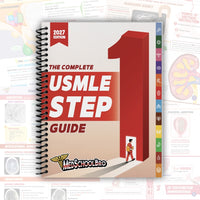
Immunology is easiest to retain when it's connected to the drugs and bugs around it. The Complete USMLE Step 1 Guide from MedSchoolBro integrates the disciplines within specific pathologies and disease processes, so you review immune mechanisms alongside the diseases they explain. For daily repetition, the USMLE Flashcards – Pharm, Micro, Anatomy from MedSchoolBro give you 480 illustrated physical cards, including 215 pharm and 115 micro cards for the drug and bug details that so often travel with immunology vignettes.
Frequently Asked Questions
Is immunology high-yield for Step 1? Yes. It appears as its own topic and inside nearly every organ system, from transplant nephrology to autoimmune hematology. Because it overlaps so heavily with microbiology and pharmacology, strong immunology helps you on questions that don't look like immunology at first.
What's the fastest way to learn immunodeficiencies? Group them by the broken arm of the immune system, then attach one signature clue to each. Delayed cord separation means LAD. Catalase-positive infections mean CGD. Hypocalcemia plus a heart defect means DiGeorge. Practice questions will lock these in faster than rereading.
How do I keep the hypersensitivity types straight? Remember that types I to III involve antibodies and type IV involves T cells. Then anchor each type to one or two classic examples, like anaphylaxis for type I, Goodpasture for type II, serum sickness for type III, and the PPD test for type IV.
When should I study immunology during dedicated? Many students cover it early, since it supports microbiology, pharmacology, and pathology. Pair it with microbiology if you can, and keep reviewing it through mixed questions until test day.