You finish your surgery rotation, sit for the shelf, and a week or two later get a number back. Maybe it's a 74. Maybe it's an 81. And you have absolutely no idea whether that's honors-worthy, solidly average, or a problem.
That confusion is almost universal in third year. Shelf scores don't look like Step scores, every clerkship seems to grade differently, and the classmate who "did great" on medicine might have scored lower than you did on psych.
Here's how shelf scores and percentiles actually work, and how to figure out what yours means.
How Do Shelf Exam Percentiles Work?
NBME clinical science subject exams, better known as shelf exams, report a scaled score that reads like a percent correct, and NBME converts that score into a percentile rank based on norms from a reference group of first-time takers at US medical schools. Your percentile tells you what percentage of that reference group scored at or below you.
The key thing to understand: each subject has its own norms. The same score can land at a very different percentile on the Medicine shelf than on the Psychiatry shelf, so you can't compare raw numbers across rotations. NBME also accounts for when in the academic year you take the exam, since students later in third year generally score higher than students on their first rotation.
For exact, current conversions between scores and percentiles, check NBME's subject examination score interpretation materials and your school's clerkship grading policy. Your school's clerkship office can usually tell you which norms they use.
The NBME Shelf Exams and How They're Scored
Which Shelf Exams Exist
NBME offers clinical science subject exams in Ambulatory Care, Clinical Neurology, Family Medicine (Modular), Medicine, Obstetrics and Gynecology, Pediatrics, Psychiatry, and Surgery, plus advanced exams in Emergency Medicine and Internal Medicine. Most students take a core set of these during their clerkship year, depending on how their school structures rotations.
What the Score Means
Shelf scores are equated, which means NBME adjusts for differences in difficulty between exam forms. A given score reflects roughly the same level of performance no matter which form you got. It looks like a percent correct, but it isn't a simple count of the questions you got right.
Why Timing in the Year Matters
A student taking the Medicine shelf as their first rotation has seen far less clinical material than a student taking it after five other clerkships. NBME has historically provided norms that account for this, and many schools compare your score against students who took the exam at a similar point in the year. That's fairer, but it also means a score that's great early in the year might look closer to average if you'd taken it later.
What Shelf Percentiles Mean for Your Grade
Here's where it gets messy: NBME reports scores and percentiles, but your school decides what they mean for your grade.
Passing Thresholds
Many schools set a minimum shelf performance to pass the clerkship. In general, these thresholds tend to sit fairly low on the percentile scale, often somewhere in roughly the bottom 5–20% depending on the school. If you're above that line, the shelf usually won't be what fails you.
Honors Thresholds
For honors, schools often look for a shelf score in roughly the top 10–40% of the reference group, combined with strong clinical evaluations. Some schools use a fixed percentile cutoff, some use a score cutoff, and some blend the shelf into a weighted composite with evaluations and other assessments. The range is wide, so your school's policy is the only number that truly matters.
How Much the Shelf Counts
The weight of the shelf in your final clerkship grade varies a lot. At some schools, it's a significant chunk of your grade. At others, clinical evaluations dominate and the shelf is closer to a pass/fail checkpoint. Read your clerkship syllabus at the start of every rotation so you know what you're aiming for.
How to Estimate Your Shelf Percentile Before Test Day
Step 1: Use NBME Practice Forms
The NBME Clinical Science Mastery Series offers practice forms for Neurology, Emergency Medicine, Family Medicine, Medicine, OB/GYN, Pediatrics, Psychiatry, and Surgery. Each form is $21, has 50 questions, runs 1 hour 15 minutes at standard pace, and translates your performance to an approximate subject-exam score. That's the closest thing to a real shelf preview you can get.
Step 2: Take One Early and One Late
Taking a form in the first half of your rotation shows you where your gaps are while there's still time to fix them. Taking another in the final week tells you whether your studying is working and roughly where you're likely to land.
Step 3: Compare Against Your School's Thresholds
Once you have an approximate score, compare it to your school's pass and honors cutoffs. If you're close to a threshold, focus your final days on the highest-yield topics for that rotation instead of trying to cover everything.
Step 4: Do Questions Every Day of the Rotation
Steady question practice throughout the rotation tends to beat cramming at the end. Even a modest daily block keeps you tuned to NBME-style questions and helps your clinical reasoning on the wards at the same time. For a rotation-by-rotation plan, see our shelf exam study guide by rotation.
What Most Students Get Wrong About Shelf Exam Percentiles
The first mistake is comparing scores across rotations. Each shelf has its own norms, so an 80 on one exam and an 80 on another can mean very different things. Compare your percentile within a subject, not your raw score across subjects.
The second mistake is relying on classmates' or forum cutoffs. "You need an 85 for honors" might be true at one school and completely wrong at yours. Shelf exam percentiles only matter in the context of your school's grading policy.
The third mistake is ignoring the timing effect. If your first rotation shelf feels like a struggle, that's expected. You're being compared fairly, but you're also earlier on the learning curve than students taking it later.
The fourth mistake is treating shelves as separate from Step 2 CK. Everything you learn for your shelves feeds directly into Step 2 CK. Students who study well for each shelf tend to start dedicated Step 2 CK prep from a much stronger position.
Studying for Shelves and Step 2 CK at the Same Time
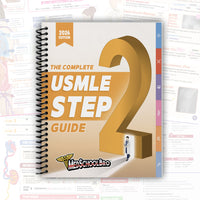
Because shelf content and Step 2 CK overlap so heavily, the smartest move is using resources that serve both. The Complete USMLE Step 2 Guide from MedSchoolBro is a 300-page hardcover with an eBook built to cover both shelf exams and Step 2 CK, so the review you do on each rotation carries straight into dedicated. Pair it with the Step 2 CK Question Bank from MedSchoolBro for 2,000+ NBME-style questions you can work through rotation by rotation.
Frequently Asked Questions
What is a good shelf exam percentile? It depends on your school's grading policy. Passing thresholds often sit roughly in the bottom 5–20%, while honors often require something in roughly the top 10–40%, usually combined with strong clinical evaluations. Check your clerkship syllabus for the exact cutoffs.
Are shelf exam scores the same as percent correct? Not exactly. Shelf scores are equated scaled scores that read like a percent correct, but they're adjusted for differences in form difficulty, so they aren't a simple count of questions answered correctly.
Why does my shelf percentile change depending on when I take it? Students later in the clerkship year have more clinical experience and tend to score higher. NBME has historically provided norms that account for timing, so the same score can map to a different percentile depending on when in the year you tested.
Where can I find official shelf exam percentiles? NBME publishes score interpretation materials for its subject exams, and your school receives the norms it uses for grading. Your clerkship office is the best place to ask which norms apply to you.