You search "best MCAT prep books," open three Reddit threads, and walk away with fourteen recommendations, two of which directly contradict each other. Someone swears by a massive box set. Someone else says books are a waste and you should just do questions. Your cart is full and you haven't studied a single page.
That feeling is incredibly common, and it's not a sign you're bad at this. It's a sign that most advice about MCAT books skips the most important question: what do you actually need a book to do?
Let's answer that first, then talk about what's worth buying.
What Are the Best MCAT Prep Books?
For most students, the best setup is simple: one comprehensive content-review resource, the official AAMC practice materials, and a dedicated source of practice questions. That's it. You don't need three competing book sets, and owning more content review rarely translates into a higher score. The rule of thumb is one primary content source, read actively, then a hard pivot to practice.
Which content resource is "best" depends on three things: how much time you have, how strong your science foundation already is, and whether you learn better from dense text or from visual, condensed review. The best MCAT prep books for a biology major with six months are not the same as the best ones for a career-changer with three months and a full-time job.
And no matter which book you pick, the official AAMC materials are non-negotiable. They're written by the people who write the test, and nothing else simulates the real exam's reasoning style as closely.
The Main Types of MCAT Prep Books
Multi-Volume Subject Review Sets
These are the big box sets you've seen recommended everywhere, with a separate book for each subject (biology, biochemistry, general chemistry, organic chemistry, physics, psychology/sociology, and CARS). Kaplan, The Princeton Review, and Examkrackers are the names you'll see most often. They're thorough and detailed, which makes them great as a reference. The tradeoff is volume: reading every page of a full set takes a long time, and many students burn weeks on content review they didn't need.
Single-Volume Comprehensive Guides
A single guide condenses the high-yield content across all sections into one book. This works well if you already have a decent science base and want to review efficiently rather than relearn every course from scratch. It's also easier to actually finish, which matters more than people admit. A book you complete beats a set you abandon halfway through organic chemistry.
Practice Question Books
Some books are just passages and questions, organized by subject. They're useful for targeted practice in a weak area, but if you're also using an online question bank, there's a lot of overlap. Pick one primary question source and go deep with it.
CARS-Specific Practice
CARS isn't really a content section, so "studying" it from a content book doesn't do much. What helps is a steady supply of practice passages and careful review of why each wrong answer is wrong. If CARS is your weakest section, prioritize practice passages over any CARS strategy book.
Official AAMC Materials
The AAMC sells its own prep (available through store.aamc.org), including the Official Guide to the MCAT Exam, question packs, section bank questions, and full-length practice exams. These aren't content review, so they won't teach you the science. What they do is show you exactly how the test thinks, and that makes them the most valuable practice you can buy. Save the full-length exams for the later part of your prep, once your content is in place.
How to Choose the Right Books for Your Situation
Start With a Diagnostic
Before buying anything, take a diagnostic or a timed practice section. The free MCAT full-length on MedSchoolGuru works well here: it gives you a scaled score and percentile at no cost. Your results tell you what kind of help you need. Big gaps across multiple sciences point toward a more detailed resource. A solid baseline with a few weak spots points toward a condensed guide plus targeted practice.
Match the Resource to Your Timeline
With six months or more, you can afford a detailed set and still leave time for practice. With three months or less, a full multi-volume set can eat your entire timeline before you've done a meaningful number of passages. Shorter timelines almost always favor a condensed guide and early, heavy question practice.
Be Honest About How You Learn
If dense paragraphs put you to sleep, a dense biology textbook won't magically become engaging because it's on a recommended list. Visual learners often do better with resources built around diagrams, tables, and illustrated summaries. Pick the book you'll actually open every day.
Check the Edition
The current MCAT format, including the Psychological, Social, and Biological Foundations of Behavior section, launched in 2015. Make sure anything you buy, especially used, is written for the current exam. A cheap pre-2015 set will be missing psych/soc entirely and will spend time on content that's no longer tested in the same way.
How to Actually Use Your Prep Books
Buying the right book is only half the battle. How you use it matters just as much.
Read actively, not passively. After each chapter, close the book and explain the key ideas out loud or on paper. If you can't, you didn't learn it, you just read it.
Turn what you read into review. Make flashcards (or use a premade set) for terms, equations, and pathways as you go, so content from week two doesn't fade by week eight.
Do questions alongside content, not after it. Even a handful of passages per chapter helps you see how the MCAT actually tests what you just read. Waiting until you've "finished content" to start practice is one of the most common timeline mistakes.
Use the book as a reference later. Once you shift into heavy practice, your book becomes the place you go to patch specific gaps exposed by missed questions. That's where a well-organized resource really earns its price.
If you're wondering how many full-lengths to plan for once content is done, our guide on how many practice tests to take before the MCAT breaks it down.
What Most Students Get Wrong About MCAT Prep Books
The biggest mistake is buying too much. More books feel like more preparation, but every extra set splits your attention and your time. Students with two full content sets often finish neither. One resource you know inside and out beats three you've skimmed.
The second mistake is treating reading as studying. Content review feels productive because you're turning pages and highlighting. But the MCAT is a reasoning test built around passages, and the score gains come from practice and careful review of mistakes, not from a fourth read-through of the same chapter.
The third mistake is ignoring the official materials until the very end, then discovering that the AAMC's question style feels different from everything else you've practiced. Work AAMC questions into your schedule early enough that you have time to adjust.
A Prep Book Built to Be Finished
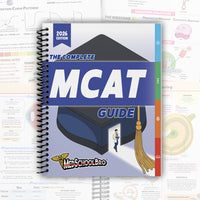
If you want one content resource that covers what matters without burying you in a box set, The Complete MCAT Guide from MedSchoolBro is a 225-page hardcover with an interactive eBook, built to condense high-yield MCAT content into something you can actually get through and come back to as a reference. It pairs naturally with AAMC practice and a question bank, so your content review stays focused and your time goes where the points are.
Frequently Asked Questions
Do I need a full multi-book MCAT set? Not necessarily. Full sets are helpful if you have big content gaps and plenty of time. If you have a solid science foundation or a shorter timeline, a single comprehensive guide plus heavy practice is often a better use of your hours.
Are used or older MCAT prep books okay? Used books can save a lot of money, as long as they're written for the current exam format that launched in 2015. Avoid anything older, since it won't cover psychology and sociology properly. Minor differences between recent editions usually don't matter much.
Are prep books enough to do well on the MCAT? Books handle content, but the MCAT tests applying that content to unfamiliar passages. You'll also want a solid question bank and the official AAMC practice materials. Think of books as the foundation and practice as the part that actually moves your score.
What's the best MCAT prep book for CARS? CARS improves more from practice passages than from any book. Use official AAMC CARS practice and a steady volume of passages, and spend real time reviewing why the right answer is right and each wrong answer is wrong.