If you're asking this question, you're probably early in medical school — or you're deep in preclinical coursework and starting to hear whispers about dedicated study, Anki decks with 50,000 cards, and classmates who study 12 hours a day for weeks on end.
The honest answer is that Step 1 is hard. But "hard" is a vague word that doesn't actually help you prepare. What's more useful is understanding exactly why it's hard, what that difficulty actually looks like, and what separates the students who feel ready on exam day from those who don't.
Let's break it down.
What Makes Step 1 So Difficult
Step 1 isn't hard the way an organic chemistry final is hard. It's a different kind of hard — and that distinction matters.
The Volume Is Enormous
Step 1 covers virtually every basic science you've studied in your first two years: biochemistry, physiology, pathology, pharmacology, microbiology, immunology, anatomy, embryology, behavioral science, and more. You're not being asked to master one subject — you're being asked to integrate all of them simultaneously.
The breadth alone is enough to overwhelm most students. There's no shortcut around it. The goal isn't to memorize everything — it's to prioritize the right things and understand them deeply enough to apply them.
It Tests Concepts, Not Just Facts
This is the part that surprises most first-year students. Step 1 doesn't ask "what is the mechanism of metformin?" It shows you a patient with type 2 diabetes, mentions a drug, and asks which side effect they're most at risk for given their renal function. You need the fact and the clinical reasoning to connect it.
The questions are written to catch students who memorized isolated facts without understanding the underlying concept. If you've been studying by reading and re-reading, you're not building the skills the exam actually tests.
The Format Is Grueling
On exam day, you sit through 280 questions across seven one-hour blocks. That's a full day of sustained mental effort — around 8 hours in the test center. Most students find that fatigue becomes a real factor by blocks 5 and 6, even when they've practiced extensively.
Stamina isn't something you can build overnight. Students who don't take full-length practice exams during dedicated often underestimate how much this affects their real score.
The Stakes Feel High
Step 1 moved to pass/fail in 2022, which has relieved some pressure. But it's still a major milestone, and the psychological weight of preparing for it — the months of dedicated study, the lifestyle sacrifice, the constant comparison to classmates — adds a layer of difficulty that goes beyond the content itself.
How Hard Is It Really? What Students Say
Ask any resident or attending about their Step 1 experience and most will describe it as the hardest single exam they've ever taken — harder than the MCAT, harder than any medical school final.
That's partly because of the volume, partly because of the stakes, and partly because the dedicated study period is its own endurance event. Six to ten weeks of 10–12 hour study days, high-volume question practice, and constant self-assessment takes a toll.
But here's the other side: hundreds of thousands of students pass Step 1 every year. The pass rate for first-time US medical school test takers has historically been above 90%. The exam is hard, but it's very passable — and for most students, a well-structured dedicated period is enough to get there.
What Separates Students Who Struggle From Those Who Don't
The difficulty of Step 1 is not distributed evenly. Some students find dedicated grueling but manageable. Others feel blindsided on exam day. The difference almost always comes down to preparation approach, not raw intelligence.
Students who struggle tend to study passively (re-reading First Aid, watching videos without active recall), start question banks too late, skip practice exams, and study without checking their score trajectory against NBMEs.
Students who do well tend to start UWorld early and treat questions as a learning tool, review wrong answers obsessively, take full-length NBMEs regularly, and know their weak systems — allocating time accordingly instead of covering everything equally.
The exam is hard. But it's also very learnable if your approach is right.
The Truth About Step 1 Prep Nobody Tells You
More time doesn't automatically mean a better score. A student who studies for 8 focused, question-heavy weeks will almost always outscore a student who studied passively for 12 weeks. The mechanism matters more than the duration. Step 1 rewards active retrieval, clinical application, and pattern recognition — not the number of hours logged.
The other thing nobody mentions: your first NBME is going to feel humbling, and that's normal. Most students score 15–25 points below their final score on their first practice exam. Your baseline is a starting point, not a ceiling.
Building a Foundation That Makes Step 1 Manageable
Step 1 gets a lot harder when you're trying to learn everything from scratch during dedicated. It gets a lot more manageable when you walk in with a strong conceptual foundation and spend dedicated reinforcing and applying it.
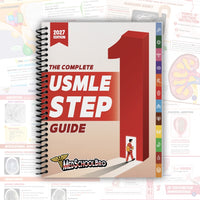
The MedSchoolBro Step 1 Bundle is built to give you exactly that — high-yield coverage across all major systems, organized around the concepts and connections that Step 1 actually tests. It's designed to be used throughout preclinical years and during dedicated, so you're not cramming everything into six weeks.
Final Thoughts
Step 1 is hard — genuinely hard. The volume is enormous, the questions require real conceptual understanding, and the exam day is a physical and mental endurance test. It deserves to be taken seriously.
But it's also one of the most well-understood exams in medical education. The resources are excellent, the format is consistent, and students who prepare strategically pass at very high rates. Understand what makes it hard, build your approach around that reality, and give yourself enough time to actually prepare.
You can do this.
Frequently Asked Questions
Is Step 1 harder than the MCAT?
Most medical students who've taken both say Step 1 is harder. The MCAT tests breadth across sciences and critical reasoning. Step 1 goes deeper, requires integrating multiple disciplines into clinical reasoning, and covers far more total material. The dedicated study period is also longer and more intensive than typical MCAT prep.
What is a passing score for Step 1?
As of 2022, Step 1 is reported as pass/fail — there is no numerical score on your transcript, only pass or fail. The USMLE sets a minimum passing standard, which historically corresponds to roughly 194 on the old scoring scale.
How long does it take to study for Step 1?
Most students spend 6–10 weeks in dedicated study. A baseline NBME at the start of dedicated will help you calibrate how much time you actually need. The most important factor isn't the number of weeks — it's how efficiently you use them.