If you are currently staring down a mountain of organic chemistry textbooks and wondering if there is a loophole, you aren't alone. Every pre-med at some point types do all med schools require the MCAT? into a search bar, hoping to find a hidden backdoor to becoming a doctor without taking the 7.5-hour exam.
The short answer? Yes, for traditional applicants, essentially every medical school in the United States and Canada requires the MCAT.
However, the medical admissions landscape is vast, and there are a few highly specific, non-traditional pathways where the MCAT is waived. Here is the reality of the MCAT requirement in 2026, the exceptions to the rule, and why trying to avoid the exam is usually a mistake.
The Traditional Route: Non-Negotiable
If you are a traditional applicant—meaning you are currently in your junior or senior year of college, or you have already graduated and are applying through the standard AMCAS, AACOMAS, or TMDSAS portals—you must take the MCAT.
There are currently no reputable, accredited MD or DO programs in the U.S. that waive the MCAT for standard, open-pool admissions. Medical schools use the MCAT as a great equalizer. It is the only metric that standardizes a 4.0 GPA from a small liberal arts college against a 3.5 GPA from an Ivy League university.
If you apply without an MCAT score, your application will simply not be reviewed.
The Exceptions: How Some Students Skip the MCAT
While traditional applicants cannot avoid the test, there are three specific pathways where the MCAT is either waived or heavily de-emphasized.
1. BS/MD and BA/MD Programs
These are highly competitive, combined undergraduate and medical school programs. You apply to them as a senior in high school. If accepted, you are guaranteed a spot in the medical school after completing your bachelor's degree, provided you maintain a high GPA.
- Examples: Brown University's PLME (the only Ivy League program of its kind) and the CUNY School of Medicine do not require the MCAT to transition to the medical phase.
- The Catch: Many BS/MD programs have reinstated an MCAT requirement in recent years, though they often just require a minimum threshold (e.g., a 504 or 509) rather than a competitive 515+.
2. Early Assurance Programs (EAP)
These programs allow college sophomores or juniors to apply to an affiliated medical school early. If accepted, you are conditionally guaranteed a seat for after graduation, freeing you up to take diverse electives without stressing over the MCAT.
- Examples: The University of Pittsburgh and the University of Toledo MedStart programs offer MCAT waivers for accepted EAP students.
- The Catch: You must have an absolutely flawless academic record and exceptional extracurriculars by your sophomore year to even be considered.
3. Certain Osteopathic (DO) Programs via LECOM
The Lake Erie College of Osteopathic Medicine (LECOM) utilizes an Academic Index Score (AIS) that factors in your SAT/ACT scores and GPA. For certain applicants, this AIS can be used in lieu of an MCAT score.
The Danger of Avoiding the MCAT
If you are not a high school senior or a college sophomore with a 4.0 GPA, you have to face the music.
Some students try to avoid the MCAT by applying to international medical schools (like those in the Caribbean) that sometimes have looser testing requirements. Do not do this. Skipping the MCAT now will only hurt you later.
The MCAT does not just test science; it tests your ability to take a grueling, multi-hour standardized exam. If you cannot pass the MCAT, you will severely struggle with the USMLE Step 1, Step 2 CK, and your specialty board exams. Medical training is a lifetime of high-stakes testing.
Don't Avoid It. Conquer It.
The MCAT is terrifying because the volume of information is overwhelming. But it is entirely beatable when you stop reading dense textbooks and start studying visually.
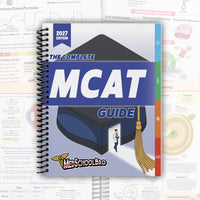
That is exactly why we built The Complete MCAT Bundle.
We removed the textbook fluff and replaced it with custom-illustrated, interactive study guides that break down the exact high-yield concepts the AAMC tests. It helps you digest the hardest topics in biochemistry, physics, and psychology so you can actually understand the material instead of just highlighting it.
You have to take the MCAT. But you don't have to suffer through the prep. Get the visual frameworks, put in the hours, and get the score that gets you accepted.