Anatomy has a reputation problem in Step 1 prep. Students either ignore it entirely — figuring it's low-yield compared to pathology and pharmacology — or go way too deep, spending hours on cadaver-lab-level detail that won't show up on the exam. Both approaches waste time. Anatomy is on Step 1, and it shows up in ways that catch underprepared students off guard: cross-sectional imaging, nerve injury scenarios, vascular supply questions, and embryology-based clinical vignettes.
The trick isn't studying more anatomy. It's studying the right anatomy, with the right resource, at the right depth.
How Step 1 Tests Anatomy
Before picking a resource, you need to understand what Step 1 actually asks. The exam doesn't test anatomy the way your gross anatomy course did. You won't be asked to identify every branch of the brachial plexus from a cadaver photo or name the attachments of a muscle you've never heard of clinically.
Step 1 anatomy questions are almost always clinically framed. A patient presents with a nerve injury after a fracture, and you need to identify which nerve is damaged based on the motor or sensory deficit. A CT scan shows a mass, and you need to know which structure it's compressing. An embryological defect produces a clinical finding, and you need to trace it back to the developmental error.
The high-yield anatomy topics for Step 1 fall into a few predictable categories: nerve injuries and their clinical presentations, vascular anatomy (especially collateral circulation and watershed areas), embryology (particularly defects that produce clinical syndromes), cross-sectional anatomy (CT and MRI interpretation), and anatomical relationships that explain surgical or clinical complications.
If your anatomy resource doesn't emphasize these clinical connections, it's not built for Step 1.
What Makes a Good Step 1 Anatomy Resource
Clinical Framing Over Exhaustive Detail
The best anatomy resource for Step 1 teaches anatomy through clinical scenarios, not through exhaustive regional dissection. You need to know that the recurrent laryngeal nerve loops under the aortic arch on the left — not because it's an interesting anatomical fact, but because thyroid surgery or a mediastinal mass can damage it and cause hoarseness. A resource that teaches the nerve's path without connecting it to the clinical presentation is making you do the integration work yourself, which is slower and less reliable under exam pressure.
Visual Learning Built In
Anatomy is inherently spatial. A resource that's purely text-based forces you to build mental images from scratch, which is inefficient. The best Step 1 anatomy resources use annotated diagrams, clinical imaging, and cross-sectional views that match how the exam presents anatomy — not as isolated structures on a dissection table, but as structures in context with their neighbors, the way they appear on CT, MRI, or in a surgical field.
Focused Scope
A comprehensive anatomy atlas is a reference tool, not a study tool. For Step 1, you want a resource that has already filtered for high-yield content — one that tells you which 20% of anatomy accounts for 80% of Step 1 questions, so you're not spending time on structures that won't appear on your exam.
The Anatomy Resources Worth Your Time
For Content Review: MedSchoolBro Step 1 Bundle
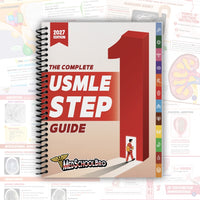
The Step 1 Bundle from MedSchoolBro covers anatomy the way Step 1 tests it — organized by system, clinically framed, and focused on the relationships and presentations that actually show up in questions. Instead of a standalone anatomy module that's disconnected from the rest of your prep, anatomy is woven into the organ-system content where it's relevant: brachial plexus injuries in the MSK section, cranial nerve palsies in neuro, embryological defects alongside the pathology they produce.
This integration matters because Step 1 doesn't test anatomy in isolation. A question about a posterior cord brachial plexus injury is also a neurology question and a clinical reasoning question. Studying anatomy within that clinical context — rather than as a separate subject you have to mentally connect later — is more efficient and produces better recall under exam conditions.
For Question Practice: MedSchoolGuru QBank
MedSchoolGuru includes anatomy-tagged questions that test the clinical application of anatomical knowledge — the nerve injuries, vascular territories, and embryological defects that Step 1 favors. Doing anatomy questions in a QBank is the best way to calibrate your depth: if you're getting anatomy questions right, your knowledge is sufficient. If you're missing them, the explanations tell you exactly what you need to review.
The combination of MedSchoolBro for content and MedSchoolGuru for questions gives you both the learning and the testing sides of anatomy prep without redundancy.
For Visual Reference: An Anatomy Atlas (Supplemental Only)
A resource like Netter's or a similar anatomy atlas is useful as a reference — something you pull up when a question explanation mentions a structure you can't visualize. It's not a primary study tool for Step 1. Don't sit down and read an atlas cover to cover. Instead, use it on demand: you miss a question about the posterior triangle of the neck, you open the atlas to see the relationships, you close it and move on.
For Spaced Repetition: Anatomy-Tagged Anki Cards
If you're using Anki (and you should be for Step 1), make sure your deck includes anatomy cards — particularly nerve injuries with their clinical presentations, vascular supply by organ, and embryological derivatives. Most popular premade decks have anatomy sections you can unsuspend as you cover each system. Custom cards for anatomy questions you miss in your QBank are also high-yield additions.
The High-Yield Anatomy Topics for Step 1
Not all anatomy is created equal on Step 1. These topics come up repeatedly and are worth dedicated study time:
Nerve Injuries
Brachial plexus injuries (Erb-Duchenne palsy, Klumpke palsy, long thoracic nerve damage causing winged scapula), peripheral nerve injuries at common fracture sites (radial nerve at the midshaft humerus, common peroneal nerve at the fibular neck, axillary nerve at the surgical neck of the humerus), and cranial nerve palsies (CN III, IV, VI for eye movement; CN VII for facial weakness patterns; CN X for voice and swallowing).
Vascular Anatomy
Coronary artery territories and which wall of the heart each supplies (LAD → anterior, RCA → inferior, LCx → lateral), watershed areas and their vulnerability to hypoperfusion (splenic flexure, ACA/MCA border zone), and portal-systemic anastomoses (esophageal varices, caput medusae, hemorrhoids).
Embryology
Neural crest cell derivatives (think: melanocytes, Schwann cells, adrenal medulla, pharyngeal arch cartilage), pharyngeal arch derivatives (especially arches 1, 2, 3, 4, 6 and their nerves), fetal circulation and the transition at birth (ductus arteriosus → ligamentum arteriosum, foramen ovale → fossa ovalis), and common developmental defects (Meckel's diverticulum, tracheoesophageal fistula, horseshoe kidney).
Cross-Sectional Anatomy
Mediastinal structures and their spatial relationships (which structures are anterior vs. posterior, what a widened mediastinum means), abdominal organ relationships (retroperitoneal structures — SAD PUCKER mnemonic), and pelvic anatomy (especially ureter course relative to uterine artery, relevant for surgical complications).
GI and Referred Pain Patterns
Referred pain from the diaphragm to the shoulder (phrenic nerve, C3-C5), referred pain from the heart to the left arm and jaw, and the anatomical basis for McBurney's point, Murphy's sign, and other classic exam findings.
How to Study Anatomy Efficiently for Step 1
Don't Study It as a Standalone Subject
The biggest mistake students make with anatomy is treating it as a separate study block. You don't need "anatomy week" during dedicated. Instead, study anatomy as it comes up within each organ system. When you're doing cardiology, learn coronary artery anatomy. When you're doing neurology, learn brachial plexus and cranial nerves. When you're doing GI, learn the portal system and retroperitoneal structures. This approach is faster, produces stronger clinical connections, and matches how the exam actually tests anatomy.
Use Questions to Set Your Depth
Your QBank is the best gauge of whether you know enough anatomy. If you're consistently getting anatomy-tagged questions right, you don't need to go deeper. If you're missing them, the explanations will point you to exactly what you need to review. Let your question bank performance drive your anatomy study, not a checklist of every structure in the body.
Prioritize Clinical Correlations Over Pure Anatomy
For every anatomical fact you study, connect it to a clinical scenario. Don't just memorize that the left recurrent laryngeal nerve passes under the aortic arch — know that a Pancoast tumor or aortic aneurysm can compress it, causing hoarseness. Don't just memorize that the ureter crosses under the uterine artery — know that this is why ureteral injury is a risk during hysterectomy. These clinical connections are what Step 1 tests, and they're what make anatomy facts stick in memory.
Skip the Low-Yield Deep Cuts
You don't need to know the exact origin and insertion of every muscle. You don't need to memorize every arterial branch of the celiac trunk. You don't need detailed knowledge of the pterygopalatine fossa. If a topic never shows up in your question bank and isn't in your high-yield content resource, it's probably not worth dedicated study time. In the pass/fail era, being strategic about what you skip is just as important as being thorough about what you study.
Putting It Together
A complete anatomy strategy for Step 1 needs three things: a clinically framed content resource that covers anatomy at the right depth, a question bank that tests your ability to apply anatomical knowledge in clinical scenarios, and spaced repetition to retain the high-yield facts over time.
The Step 1 Bundle from MedSchoolBro paired with MedSchoolGuru's QBank covers the first two — clinical anatomy content integrated into each organ system, plus questions that test exactly the anatomy patterns Step 1 favors. Add anatomy-tagged Anki cards for retention, and you have an efficient anatomy setup that doesn't require a separate resource or a separate study phase.
Frequently Asked Questions
Is anatomy high-yield for Step 1? It's not the highest-yield subject overall — pathology, pharmacology, and physiology carry more weight — but anatomy questions appear on every Step 1 exam, and they're often the questions students lose easy points on because they underprepared. Studying anatomy at the right depth (clinically framed, focused on nerve injuries, vascular supply, and embryology) is a relatively small time investment that prevents avoidable misses.
Do I need an anatomy atlas for Step 1? Not as a primary resource. An atlas is useful as a reference tool — something you open when you need to visualize a structure from a question you missed. But reading through an atlas systematically is not an efficient use of Step 1 prep time. Your primary anatomy learning should come from a clinically oriented resource that covers anatomy at the exam-appropriate depth.
How much time should I spend on anatomy during dedicated? Don't allocate a fixed "anatomy block." Instead, study anatomy within each organ system as you go — 15–20 minutes of anatomy review per system is usually sufficient. If your QBank performance reveals a specific anatomy weak spot (e.g., you keep missing brachial plexus questions), spend a focused hour or two on that topic. Total anatomy time during a 6-week dedicated period should be roughly 8–12 hours, spread across systems.