At some point in your Step 1 prep, you realize something: almost every question, no matter the system, comes back to pathology. A cardiology question asks what the heart looks like under the microscope. A renal question asks why the kidney failed. A pharm question asks which disease the drug treats.
That can feel overwhelming, like one subject quietly swallowed the whole exam. But it's also good news. If pathology is the backbone, then a strong pathology foundation makes everything else easier to hang in place.
Here's how to approach pathology so it organizes your studying instead of burying it.
Why Is Pathology So Important for Step 1?
Step 1 pathology is the backbone of the exam because it links basic science to disease: nearly every organ-system question asks what went wrong, why, and what it looks like. Master general pathology first (cell injury, inflammation, neoplasia, hemodynamics, and genetics), then study systemic pathology alongside the physiology and pharmacology of each organ system. The USMLE content outline lists pathology among the largest disciplines on the exam, so check usmle.org for the current percentage ranges.
It helps to think of pathology in two layers. General pathology covers the universal processes that happen in every organ, like necrosis, inflammation, and tumor growth. Systemic pathology applies those processes to specific organs: myocardial infarction, glomerulonephritis, cirrhosis, lymphoma. If you learn the general rules well, systemic pathology becomes a set of variations on themes you already know.
The High-Yield General Pathology Topics
Cell Injury and Cell Death
Know the difference between reversible injury (cellular swelling, membrane blebbing, fatty change, ribosome detachment) and irreversible injury (membrane damage plus nuclear changes: pyknosis, karyorrhexis, and karyolysis). Then learn the necrosis types and where each one shows up:
- Coagulative: ischemic infarcts in most solid organs, like the heart and kidney.
- Liquefactive: brain infarcts and abscesses.
- Caseous: tuberculosis and systemic fungal infections.
- Fat: acute pancreatitis, with saponification.
- Fibrinoid: vasculitis and malignant hypertension.
- Gangrenous: ischemia of the limbs and GI tract.
Apoptosis is different. It's programmed, uses caspases, and doesn't cause inflammation. Know the intrinsic pathway (mitochondrial, regulated by the BCL-2 family, with cytochrome c release) and the extrinsic pathway (Fas ligand and TNF).
Inflammation and Repair
Acute inflammation is neutrophil-driven. Learn the steps of leukocyte extravasation: rolling (selectins), tight binding (ICAM-1 on endothelium with LFA-1 integrin on leukocytes), diapedesis (PECAM-1), and migration toward chemotactic signals like C5a, IL-8, and LTB4. Chronic inflammation brings in macrophages and lymphocytes, and granulomas show up in conditions like tuberculosis and sarcoidosis. Wound healing and the role of growth factors round out this topic.
Neoplasia
Know oncogenes (gain of function, one hit needed) vs tumor suppressor genes (loss of function, usually two hits, like RB and TP53). Learn the common tumor markers, such as PSA, AFP, CA-125, CEA, and hCG, and the classic paraneoplastic syndromes: small cell lung cancer with ACTH or SIADH, squamous cell lung cancer with PTHrP-driven hypercalcemia, and renal cell carcinoma with erythropoietin-driven polycythemia.
Hemodynamics
Virchow's triad (stasis, endothelial injury, hypercoagulability) explains most thrombosis questions. Learn the embolus types, especially fat emboli after long bone fractures. Know red vs pale infarcts: red infarcts happen in tissues with dual blood supply or with reperfusion, like the lung and liver, while pale infarcts happen in solid organs with a single blood supply, like the heart, kidney, and spleen. And know the four shock types: hypovolemic, cardiogenic, distributive, and obstructive.
Genetics
Inheritance patterns, trinucleotide repeat disorders like Huntington disease, fragile X syndrome, myotonic dystrophy, and Friedreich ataxia, plus anticipation, show up across the exam.
How to Study Systemic Pathology With Physiology and Pharm
Step 1 rarely asks pathology in isolation. It asks you to connect normal function, what broke, and how we treat it. So study each organ system in that order.
| System | Physiology first | Then pathology | Then pharmacology |
|---|---|---|---|
| Cardiovascular | Cardiac cycle, pressure-volume loops | Atherosclerosis, MI, heart failure, valve disease | Beta-blockers, ACE inhibitors, nitrates, statins |
| Renal | Filtration, tubular transport, acid-base | Nephritic and nephrotic syndromes, acute kidney injury | Diuretics, drugs that harm the kidney |
| Hematology | Hematopoiesis, coagulation cascade | Anemias, leukemias, lymphomas, bleeding disorders | Anticoagulants, chemotherapy agents |
| Gastrointestinal | Digestion, bilirubin metabolism | Inflammatory bowel disease, cirrhosis, GI cancers | Acid suppressants, IBD drugs |
When you hit a disease, ask three questions: What normal process failed? What does it look like on gross or microscopic exam? What drug fixes it, and what's that drug's side effect? That habit turns every topic into a small integrated lesson.
Image Recognition
Step 1 includes images, and some pathology findings are classic enough that you should recognize them instantly:
- Reed-Sternberg cells: Hodgkin lymphoma
- Psammoma bodies: papillary thyroid carcinoma, serous ovarian carcinoma, meningioma, mesothelioma
- Auer rods: acute myeloid leukemia
- Keratin pearls: squamous cell carcinoma
- Mallory-Denk bodies: alcoholic hepatitis
- Aschoff bodies: rheumatic fever
- Call-Exner bodies: granulosa cell tumor
Look at images actively. Cover the caption, name the finding, then check yourself. Questions with images are the fastest way to build this skill.
A Step 1 Pathology Study Schedule
This is a sample 6-week framework for dedicated. If you're still in your preclinical years, use the same idea at a slower pace: general pathology early, then systemic pathology paired with each organ block.
- Week 1: General pathology. Cell injury, inflammation, neoplasia, hemodynamics, and genetics. Start mixed practice questions now, even if you feel unready.
- Week 2: Cardiovascular and pulmonary. Physiology, pathology, and pharmacology together.
- Week 3: Renal and gastrointestinal. Same approach, with daily question review.
- Week 4: Hematology/oncology and endocrine. Lean on your neoplasia foundation here.
- Week 5: Neurology, musculoskeletal, and reproductive. Keep earlier systems fresh with mixed blocks.
- Week 6: Mixed review and self-assessment. Focus on weak systems and timed practice.
Before you start, get a baseline. The free Step 1 Free 120 diagnostic on MedSchoolGuru is MedSchoolGuru's own question set (separate from the official NBME Free 120), gives a scaled score estimate and pass likelihood, and only needs a free account. Your results will show which systems need more than a week. For a full overview of what's tested, see our breakdown of what USMLE Step 1 covers.
Practice Vignette: Myocardial Infarction Timeline
A 64-year-old man is admitted with crushing chest pain and ST elevations in the anterior leads. He dies two days later. At autopsy, a section of the left ventricular wall is examined under the microscope. Which finding is most likely?
- A. No visible microscopic changes
- B. Extensive coagulative necrosis with a neutrophilic infiltrate
- C. Macrophages clearing necrotic debris
- D. Granulation tissue at the margins of the infarct
- E. Dense collagenous scar
Answer: B. At about 1 to 3 days after an MI, the infarct shows extensive coagulative necrosis with acute inflammation and neutrophils. In the first few hours, there may be no visible changes yet (A). Macrophages (C) and granulation tissue at the margins (D) appear roughly between 3 and 14 days. A dense scar (E) forms over weeks to months. Remember that MI causes coagulative necrosis; liquefactive necrosis is the brain's pattern after an infarct. A related favorite: fibrinous pericarditis can appear in the first few days after an MI, while free wall rupture risk peaks during the macrophage phase, when the wall is weakest.
What Most Students Get Wrong About Step 1 Pathology
The biggest mistake is jumping straight into systems without a general pathology foundation. If you don't understand necrosis or inflammation well, every organ feels like a new subject.
The second mistake is studying pathology as pictures and buzzwords alone. Buzzwords help, but Step 1 often asks about mechanisms. Know why a finding happens, not just what it's called.
The third mistake is separating path from physiology and pharm. Many students use resources like First Aid or Pathoma in parallel, which is fine, but the integration has to happen in your head. Practice questions force that integration.
The last mistake is postponing questions until content review is done. Start early and let your misses tell you what to reread.
Study Pathology the Way Step 1 Tests It
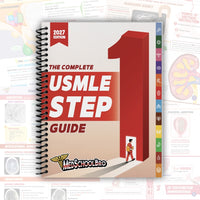
The Complete USMLE Step 1 Guide from MedSchoolBro integrates the disciplines within specific pathologies and disease processes, so physiology and pharmacology sit right next to the diseases they explain. Pair it with the Step 1 Question Bank from MedSchoolBro, which offers 2,000+ NBME-style questions, CBSE-style diagnostic self-assessments with score reports, and clinical-reasoning walkthroughs, to practice pathology in the integrated format you'll see on test day.
Frequently Asked Questions
How much of Step 1 is pathology? Pathology is one of the largest disciplines on Step 1, and it appears in nearly every organ system. The exact range is listed in the USMLE content outline, so check usmle.org for the current numbers.
Should I study general pathology or systemic pathology first? General pathology first. It teaches the processes, like necrosis, inflammation, and neoplasia, that systemic pathology applies to each organ. Many students spend roughly a week on it before moving into systems.
How do I get better at pathology images? Practice with questions that include images, and quiz yourself by covering captions before reading them. Focus first on classic findings like Reed-Sternberg cells, psammoma bodies, and Auer rods.
Is pathology still important now that Step 1 is pass/fail? Yes. Step 1 is pass/fail for exams taken on or after January 26, 2022, but you still need to pass, and pathology is central to that. A strong pathology foundation also carries forward into your clinical years.