Every class has that one person with a shelf of Step 1 books, half of them still in shrink wrap. And every class has someone who swears they passed with one book and a question bank. Somewhere between the two, you're trying to figure out what to actually buy.
The hard part isn't finding recommendations. It's that there are too many, and every one comes with a confident upperclassman attached.
Here's how to build a book list that supports your prep instead of becoming another thing you feel behind on.
What Are the Best Step 1 Books?
For most students, the best Step 1 books aren't a long list. They're a small system: one comprehensive review book as your anchor, one strong pathology resource, and targeted subject books only for your weakest areas, all paired with a question bank. The classic anchor is First Aid for the USMLE Step 1. For pathology, Pathoma is the most common pick. For physiology, BRS Physiology. For biochemistry, Lippincott Illustrated Reviews: Biochemistry.
Two or three books used deeply will do more for you than eight books skimmed. And since Step 1 is pass/fail (passing standard 196), your goal is reliable, broad competence, not memorizing every footnote in every resource.
Your Anchor: A Comprehensive Review Book
First Aid for the USMLE Step 1
First Aid is the reference most students build around. It's a dense, high-yield outline organized by discipline and system, and its biggest strength is coverage: if a concept shows up often on Step 1, there's a good chance it's in there somewhere. It works best as a hub you annotate as you do questions, not a book you read cover to cover for first exposure. Its outline format assumes you've already learned the material once.
System-Organized Guides With More Explanation
Some students find an outline too compressed to learn from, especially for topics they never fully understood in class. A system-organized guide with fuller explanations can be a better anchor for those students, or a better companion to First Aid when you need the "why" behind a fact. The key is picking one primary anchor and sticking with it, not switching back and forth.
Subject Books Worth Considering
Pathology: Pathoma and Rapid Review Pathology
Pathology is the backbone of Step 1, so it earns its own resource. Pathoma (Dr. Husain Sattar's Fundamentals of Pathology) pairs a concise book with lecture videos and explains disease mechanisms clearly. Students who want more depth sometimes add Rapid Review Pathology by Dr. Edward Goljan, but most don't need both.
Physiology: BRS Physiology
Physiology is where memorizing without understanding falls apart fast. BRS Physiology by Dr. Linda Costanzo is concise, mechanism-focused and a common pick for cardiac, renal and respiratory physiology. Students with big physiology gaps sometimes step up to her full Physiology textbook for the trickiest systems.
Biochemistry: Lippincott Illustrated Reviews
If metabolic pathways still blur together, Lippincott's biochemistry review is a strong, visual way to rebuild them: which enzyme is rate-limiting, what regulates it, and what happens clinically when it fails. Use it for targeted repair, not as a cover-to-cover read during dedicated.
Microbiology and Pharmacology
Most students handle micro and pharm through flashcards and visual mnemonics rather than another dense book, because both subjects reward fast, repeated recall more than long reading. If you want a book for micro, Clinical Microbiology Made Ridiculously Simple is a long-standing favorite for making organisms memorable.
Behavioral Science, Biostatistics and Ethics
These topics are easy to underestimate because they feel like common sense, right up until a question asks you to calculate a number needed to treat or pick the most appropriate response to a patient who refuses treatment. Most students don't need a separate textbook here. Your anchor book's coverage plus a steady stream of practice questions usually does the job, since these questions reward recognizing patterns in how the exam frames them. If biostats keeps showing up as a weakness on your practice exams, that's the point to add a short, focused review rather than a big book.
How to Choose Based on Where You Are
During MS1 and MS2
This is the best time to introduce your anchor book. Annotate it alongside lectures so your notes and board-style facts live in one place. Add subject books only when coursework leaves a real gap. You don't need a full Step 1 library in your first semester.
During Dedicated
Dedicated is not the time to start a new book. Use your anchor for consolidation and quick reference while you do questions, and pull in a subject book only for a specific weakness your practice exams keep flagging. If you're mapping out that block, our 8-week Step 1 study schedule shows how review time and question time fit together.
If You Learn Better Visually
Look for resources built around diagrams, tables and illustrated cards. The best Step 1 books for you are the ones you'll actually open every day, and format matters more than most booklists admit.
Books vs. Question Banks: Where Your Time Should Go
Books build and organize knowledge. Questions build the skill Step 1 actually tests: applying that knowledge to a clinical vignette under time pressure. Most students who pass comfortably spend the majority of dedicated on questions and explanation review, using books to fill the gaps those questions expose.
Track progress with official NBME self-assessments. The CBSSA (7 forms, from $62 each) gives you an estimated probability of passing, which tells you far more about readiness than how many pages you've finished.
What Most Students Get Wrong About Step 1 Books
The first mistake is buying too many. Every extra book splits your attention and creates another source of guilt about unfinished reading. A lean list used deeply beats a big list used shallowly.
The second is reading cover to cover in dedicated. Passive reading feels productive, but it's one of the least efficient ways to prepare for a question-based exam. Read with a purpose: to fix something a question just showed you didn't know.
The third is switching anchors mid-prep. A classmate's favorite book won't help if it means abandoning months of annotations. Consistency compounds.
The last is treating books as a substitute for questions. The best Step 1 books make your question practice more productive. They can't replace it.
A Guide Built for How You Actually Study
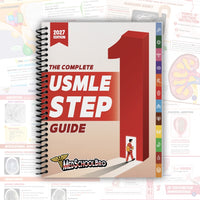
If you want an anchor that explains as well as it summarizes, The Complete USMLE Step 1 Guide from MedSchoolBro is a 381-page hardcover plus eBook, organized to support both longitudinal review and dedicated. Pair it with the USMLE Flashcards (Pharm, Micro, Anatomy) from MedSchoolBro, 480 cards built for the fast-recall subjects where flashcards beat reading.
Frequently Asked Questions
Is First Aid enough for Step 1? As your only reading resource, many students find First Aid sufficient when it's paired with a question bank and NBME self-assessments. On its own, without questions, it usually isn't. Its outline format works best once you've learned the material and need a fast, organized reference.
Do I need Pathoma if I already use First Aid? You don't strictly need it, but pathology is so central to Step 1 that many students find a dedicated pathology resource worth it. Pathoma explains mechanisms in a way that makes First Aid's pathology pages easier to retain.
Should I buy books or a question bank first? If you can only start with one, a question bank usually gives you more value, because questions reveal what you don't know. Add your anchor book early in preclinical years, then buy subject books only for gaps that keep showing up.
How many Step 1 books do I actually need? Most students do well with two or three: a comprehensive anchor, a pathology resource, and possibly one subject book for a persistent weak area. Beyond that, extra books tend to add guilt more than points. Let your practice exam results tell you whether a new resource is worth adding.
Do I need the newest edition of every book? Not always. Core basic science changes slowly, so a recent edition is usually fine. Very old editions can miss updated guidelines and current exam emphasis, so avoid anything several years out of date for your anchor book.