Pre-rounds at 4:30. Retracting for three hours while your legs go numb. Getting asked the blood supply of the stomach by a resident who seems genuinely disappointed when you hesitate. Then you get home at 7 p.m. and someone reminds you there's a shelf exam at the end of all this.
If you're wondering when exactly you're supposed to study, you're asking the right question. Surgery is the rotation where good intentions go to die, mostly because the schedule leaves so little room.
The good news: the surgery shelf is more predictable than it feels from inside the OR, and you don't need huge blocks of free time to prepare for it. You need a plan built around short sessions and the right priorities.
How Do You Study for the Surgery Shelf?
Here's the honest answer: the surgery shelf is mostly medicine in a surgical setting, so focus on trauma algorithms, acute abdomen workups, pre- and post-op management, and fluids and electrolytes, do roughly 20 to 30 questions a day in short bursts, and save NBME practice forms for your final two weeks. Surgery clerkships often run around 8 weeks, sometimes split into general surgery and subspecialty blocks, which gives you enough runway if you start in week 1 rather than week 4.
What the exam mostly doesn't test is how to do the operation. You won't be asked which suture to use for a fascial closure. You will be asked whether a hypotensive trauma patient with a positive FAST goes to CT or the OR, and what's causing a fever on post-op day 5. Figuring out how to study for surgery shelf exams starts with that shift: study decisions, not procedures.
What the Surgery Shelf Actually Tests
Trauma and the Primary Survey
Know ATLS order (airway, breathing, circulation, disability, exposure) so well that it's automatic, because many questions are really asking "what comes first?" Airway always beats imaging. A suspected tension pneumothorax is a clinical diagnosis treated with immediate decompression, not a chest X-ray. For blunt abdominal trauma, a hemodynamically unstable patient with a positive FAST goes to exploratory laparotomy, while a stable patient typically gets a CT of the abdomen and pelvis first.
The Acute Abdomen
Appendicitis, cholecystitis, small bowel obstruction, diverticulitis, pancreatitis, perforated viscus, and mesenteric ischemia make up a huge share of the exam. Learn the first imaging study for each (right upper quadrant ultrasound for suspected cholecystitis, CT for most others), the initial management (NPO, IV fluids, nasogastric decompression for an uncomplicated SBO), and the findings that mean surgery now, like peritonitis or signs of strangulation. "Pain out of proportion to exam" should make you think mesenteric ischemia every time.
Pre-Op and Post-Op Care
This is where the medicine lives. Expect questions on pre-op risk assessment, which medications to hold, post-op fluid and electrolyte problems, acid-base disturbances, and the different types of shock. Post-op fever is a classic: the "5 Ws" framework (wind, water, wound, walking, wonder drugs) is an exam-friendly way to organize causes by timing, and a high fever with rigidity during anesthesia is malignant hyperthermia until proven otherwise, treated with dantrolene.
The Subspecialty Grab Bag
Vascular, breast, endocrine, pediatric surgery, urology, orthopedics, and ENT all appear. A few patterns come up again and again:
- Projectile, non-bilious vomiting in a young infant with a hypochloremic, hypokalemic metabolic alkalosis points to pyloric stenosis.
- Bilious vomiting in a newborn is malrotation with volvulus until proven otherwise.
- Elective AAA repair is generally indicated at 5.5 cm or larger, with rapid growth, or with symptoms.
- A thyroid nodule workup starts with TSH, then moves to ultrasound and FNA based on findings.
You don't need fellowship-level depth here. You need the classic presentation, the first test, and the next step.
A Week-by-Week Surgery Shelf Study Plan
If you want a concrete picture of how to study for surgery shelf exams week by week, here it is. This plan assumes an 8-week rotation. For a shorter block, compress weeks 3 to 5 and keep the final two weeks intact.
Weeks 1 and 2: Build the Frame
- Start your question bank on day one with surgery topics selected, even if it's only 15 to 20 questions a day.
- Learn the trauma algorithm and the acute abdomen workups first. They're the highest-yield and they'll make OR conversations easier.
- Write a one-page "first test, next step" sheet for the acute abdomen and keep adding to it.
Weeks 3 to 5: Volume and Weak Areas
- Push toward 25 to 30 questions a day, broken into small sets that fit your schedule.
- Turn every miss into a short flashcard focused on the decision point.
- Rotate in the subspecialties you haven't seen clinically. If you never set foot on vascular, those questions need deliberate attention.
Week 6: First Practice Form
- Take an NBME Clinical Science Mastery Series form for Surgery. Each form is 50 questions, about 1 hour 15 minutes standard-paced, and $21, with an approximate subject-exam score.
- Review it thoroughly and rank your weakest three topics.
Weeks 7 and 8: Sharpen and Taper
- Take a second form early in week 7 or 8 to confirm your trend.
- Focus reading on your ranked weak areas plus fluids, electrolytes, and post-op complications.
- Go light the day before the exam. A rested brain reads question stems better than a tired one.
How to Study When You Have No Free Time
Micro-Sessions Beat Marathons
Five questions between cases, a flashcard session while waiting for the next patient to roll back, ten questions at lunch. On surgery, studying in 10-minute pieces isn't a compromise, it's the strategy. Keep your question bank and flashcards on your phone so you can use any gap without planning for it.
Read About Tomorrow's Cases
Look at the OR schedule the night before and spend 10 to 15 minutes on each case: the indication, the relevant anatomy, and the common complications. That reading does double duty. It prepares you for pimping in the OR, and it covers exactly the kind of indications and complications the shelf asks about.
Let Days Off Do the Heavy Lifting
If you get a day off on the weekend, that's where longer timed blocks and practice forms belong. Weekdays maintain momentum; days off move you forward.
Protect Your Sleep
It's tempting to steal hours from sleep to cram questions. On a rotation that starts before sunrise, that tradeoff usually backfires. Fewer questions with real focus are worth more than a late-night set you barely remember.
What Most Students Get Wrong About the Surgery Shelf
The most common mistake when deciding how to study for surgery shelf exams is studying for the OR instead of the exam. Detailed surgical anatomy and operative steps help you survive pimping, but they're a small slice of the shelf. Clinical decision-making is the bulk of it.
The second mistake is ignoring the medicine. Students who skip fluids, electrolytes, acid-base, and shock because they "aren't surgery" lose points that were sitting right in front of them.
The third mistake is waiting until "things calm down." On surgery, they don't. Students who plan to start questions once the rotation gets lighter often find themselves in week 6 with very little done.
And finally, students over-index on whatever service they're on. If you spent four weeks on colorectal, you'll feel great about diverticulitis and shaky on breast and vascular. The exam doesn't care what your schedule was. If you're planning across rotations, our shelf exam study guide by rotation shows how surgery fits with the rest of MS3.
Surviving Pimping and Prepping for the Shelf
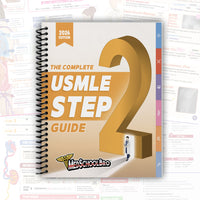
Surgery asks you to be ready in two very different settings: answering a resident's question across the table and answering exam questions at the end of the block. The 'Don't Be Pimped' Pocket Guide from MedSchoolBro fits in your white coat for quick review before cases and on rounds. For the exam itself, The Complete USMLE Step 2 Guide from MedSchoolBro is a 300-page hardcover plus eBook built for both shelf exams and Step 2 CK, so the surgery content you learn now keeps paying off later.
Frequently Asked Questions
Is the surgery shelf hard? Many students find it one of the tougher shelves, mostly because of limited study time and the amount of medicine it covers. The content itself is fairly predictable once you focus on trauma, the acute abdomen, and peri-operative care. A steady daily question habit makes a big difference.
How many questions a day should I do for the surgery shelf? Most students aim for roughly 20 to 30 a day, broken into small sets that fit around cases. Consistency beats volume here. Twenty well-reviewed questions every day will usually serve you better than 80 crammed into a Sunday.
Do I need to read a surgery textbook? Usually not cover to cover. A question bank plus a focused review resource covers most of what the shelf tests. Use textbook chapters selectively for your patients' cases and for topics you keep missing.
Does the surgery shelf help with Step 2 CK? Yes. Trauma, the acute abdomen, and peri-operative medicine all appear on Step 2 CK, and the "next best step" style of thinking is the same. Treating this shelf as early Step 2 CK prep is one of the most efficient things you can do in third year.